
Water-Swelling Bentonite Tape
Sealing tape based on sodium bentonite and butyl rubber for reliable sealing of construction joints in concrete and reinforced concrete structures. Swells up to 540% on contact with water.
Product Description
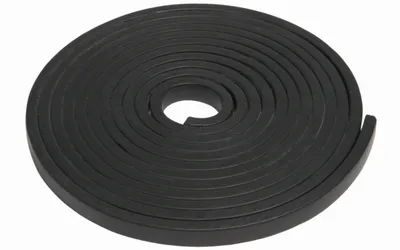
The water-swelling tape by Plast Commerce is a sealing tape based on sodium bentonite and butyl rubber, mixed in a specific ratio. The tape has a rectangular cross-section (20x25 mm), is deformable and adheres tightly to the surface of the structure on which it is installed.
The product is designed to prevent water filtration or leakage through construction (cold) joints, typical of concrete and reinforced concrete structures. On contact with water, the clay mineral montmorillonite (the main component of bentonite) absorbs water and increases its volume by up to 540%, causing the tape to swell and seal the joint.
When dry, the tape releases absorbed moisture into the concrete and returns to its original size. The process is reversible and can occur virtually an unlimited number of times during the operational life of the structure.
Advantages
The bentonite water-swelling tape provides active waterproofing by swelling on contact with water.
Swelling up to 540%
Active protection — fills all voids and cracks on contact with water
Withstands up to 3 bar
Resistance to significant water pressure
Easy installation
No welding or connectors needed, unlike PVC waterstop tapes
Wide temperature range
Works from -30°C to +90°C
Self-sealing
Automatically seals even the smallest micro-cracks in concrete
Long-lasting protection
Multiple swelling and shrinking cycles without loss of properties
New and existing structures
Applicable to both new construction and repair work
Environmentally safe
Based on non-toxic materials — clay and rubber, safe for drinking water
How It Works
Cold Joints
During concrete pouring, work is interrupted and new concrete is placed on hardened concrete — forming a cold joint, which is a weak point in the structure.
Tape Installation
The tape is glued or fixed with nails along the length of the joint in the middle of the concrete cross-section.
Swelling and Sealing
On contact with water, the bentonite swells up to 540%, sealing all irregularities and voids on both sides of the joint.
Technical Specifications
Physical and Mechanical Properties
| Material | Sodium bentonite and butyl rubber |
| Profile | 20 x 25 mm |
| Colour | Black |
| Density | ± 1.44 kg/dm³ |
| Swelling | Up to 540% in water |
| Water absorption (72 hours) | 241.5 ±7.9% |
| Water pressure resistance | Up to 3 bar |
| Elongation at break | 46.0 ±2.4% |
| Bending (90° at 0°C) | No cracking |
| Temperature range | -30°C to +90°C |
Packaging and Delivery
| Packaging unit | Cardboard box |
| Length per box | 30 m (6 rolls of 5 m) |
| Box weight | 20 kg |
| Palletisation | 30 boxes (900 m) per pallet |
| Shelf life | 2 years from date of manufacture |
Applications
- Water treatment plants, reservoirs and drinking water facilities
- Wastewater and sewage treatment plants
- Foundations, basements and elevator shafts
- Hydraulic engineering structures
- Public, private, sports and therapeutic swimming pools
- Aqua parks and recreational water facilities
- Sealing around pipelines (water supply, sewage)
- Joints between precast concrete elements and manholes
- Tunnel and mining construction
- Sealing of sheet pile walls
Installation Instructions
Quick, safe and easy installation without connectors or welding
Surface Preparation
- Surface must be dry, smooth and free of dust, stains, oils and other contaminants
- Irregularities larger than 5 mm should be removed mechanically
- Voids and cavities should be filled with non-shrink cement mortar
- Do not install in the presence of flowing water, standing water or ice
Tape Placement
- Place in the centre of the concrete cross-section
- Fix with suitable adhesive or steel nails at ~30 cm intervals
- The tape must be in full contact with the concrete along its entire surface
- Joining: butt joint or overlap of min. 5 cm
Concrete Cover
- Minimum 80 mm concrete cover on both sides
- With less cover, there is risk of concrete cracking
- Recommended concrete class: not lower than C 16/20
Protection and Precautions
- Protect the tape from moisture before concreting
- If the tape visibly swells before concreting — replace with new tape
- For vertical installation, use a protective metal mesh
- Around pipelines — form a ring, glued or fastened with wire
Storage and Important Notes
- Store in original packaging, in a dry place at +5°C to 35°C.
- Avoid contact with moisture before installation — bentonite begins to swell on contact with water.
- Not intended for expansion joints or concrete pavements.
- Swelling is not instantaneous — it takes several days.
- In a completely dry environment, the tape shrinks to its original dimensions but swells again on contact with water.
Certified Quality
Certificate No CM 281-21 / 04.08.2021 from the University of Architecture, Civil Engineering and Geodesy (UACEG). The product is made from non-toxic materials, suitable for drinking water and wastewater facilities.
Frequently Asked Questions
What is water-swelling bentonite tape and how does it work?
What is the difference between PVC waterstop and water-swelling tape?
Can it be used for drinking water?
What is the minimum concrete cover?
How are two ends of the tape joined?
Need technical consultation?
Our specialists will help you choose the right waterproofing solution for your project.